Shennong Bencao Jing
007 / 030
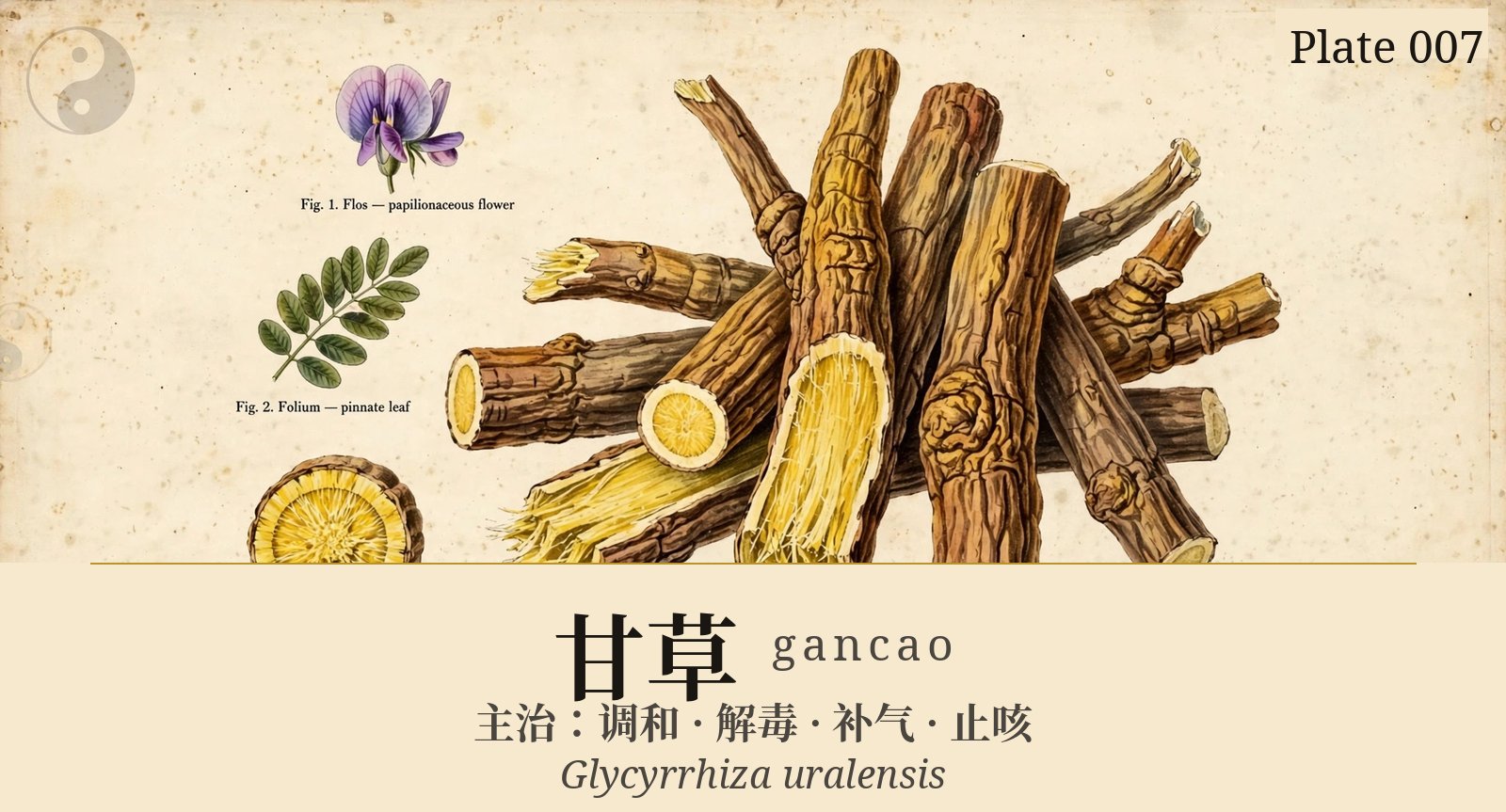
Gancao (Licorice Root) — classical plate
Glycyrrhizae Radix · Licorice Root Plate 007
Glycyrrhizae Radix
甘草 Gancao
Licorice Root
Radix et Rhizoma Glycyrrhizae
Nature & FlavorSweet; neutral
ChannelsHeart, Lung, Spleen, Stomach
Actions
HarmonizesResolves toxinsBoosts qiStops cough
Six ChannelsUsed across all six channels; harmonizes the other herbs
The Classic The original text

「味甘平。主五脏六腑寒热邪气,坚筋骨,长肌肉,倍力,金创肿,解毒。久服轻身延年。」

Sweet in flavor, neutral. It treats cold-and-heat pathogens in the five organs and six bowels, strengthens sinew and bone, grows muscle, multiplies strength, wounds and swelling from metal, and resolves toxins. Taken over a long time, it lightens the body and extends the years.

RootBro's note — The most frequently used herb in the classical formulary — it appears in nearly every formula. 'Harmonizing the other herbs' is no courtesy phrase: glycyrrhizin binds many alkaloids, physically slowing their absorption rate and lowering peak toxicity.
PhD Insight A systems-biology reading
Glycyrrhizin is hydrolyzed in the body to glycyrrhetinic acid, whose structure resembles cortisol — a natural anti-inflammatory and immunomodulatory action, while protecting the gastric mucosa.
Glycyrrhizin · 甘草酸
A cortisol-like structure → inhibits the NF-κB inflammatory pathway → broad-spectrum anti-inflammatory action. It also forms poorly soluble complexes with alkaloids → absorption slows → the physicochemical basis of 'harmonizing the other herbs.'
How licorice 'resolves toxins': glycyrrhizin binds non-covalently to alkaloids such as aconitine and pinellia toxins, lowering the concentration of free toxin. That is why formulas containing fuzi or banxia almost always include licorice — a natural detoxification design two thousand years old.
Logic Pairing Classical pairings
Gancao Tang (Licorice Decoction)Guizhi Tang (Cinnamon Twig Decoction)Shaoyao Gancao Tang (Peony & Licorice Decoction)Zhigancao Tang (Honey-Fried Licorice Decoction)Si Ni Tang (Frigid Extremities Decoction)Xiao Chaihu Tang (Minor Bupleurum Decoction)
← Previous Shaoyao · 芍药

⚠️ Safety note: This page is study material on the Chinese medical classics, offered for cultural and educational understanding only. It is not a diagnosis, a prescription, or a promise of treatment. Herbs are medicine — use them only under the guidance of a licensed practitioner, and never compound or take them on your own.

HerbBlueMap HomePain Point FinderHerb Library中文原版 · Chinese Edition (tcmus.net)