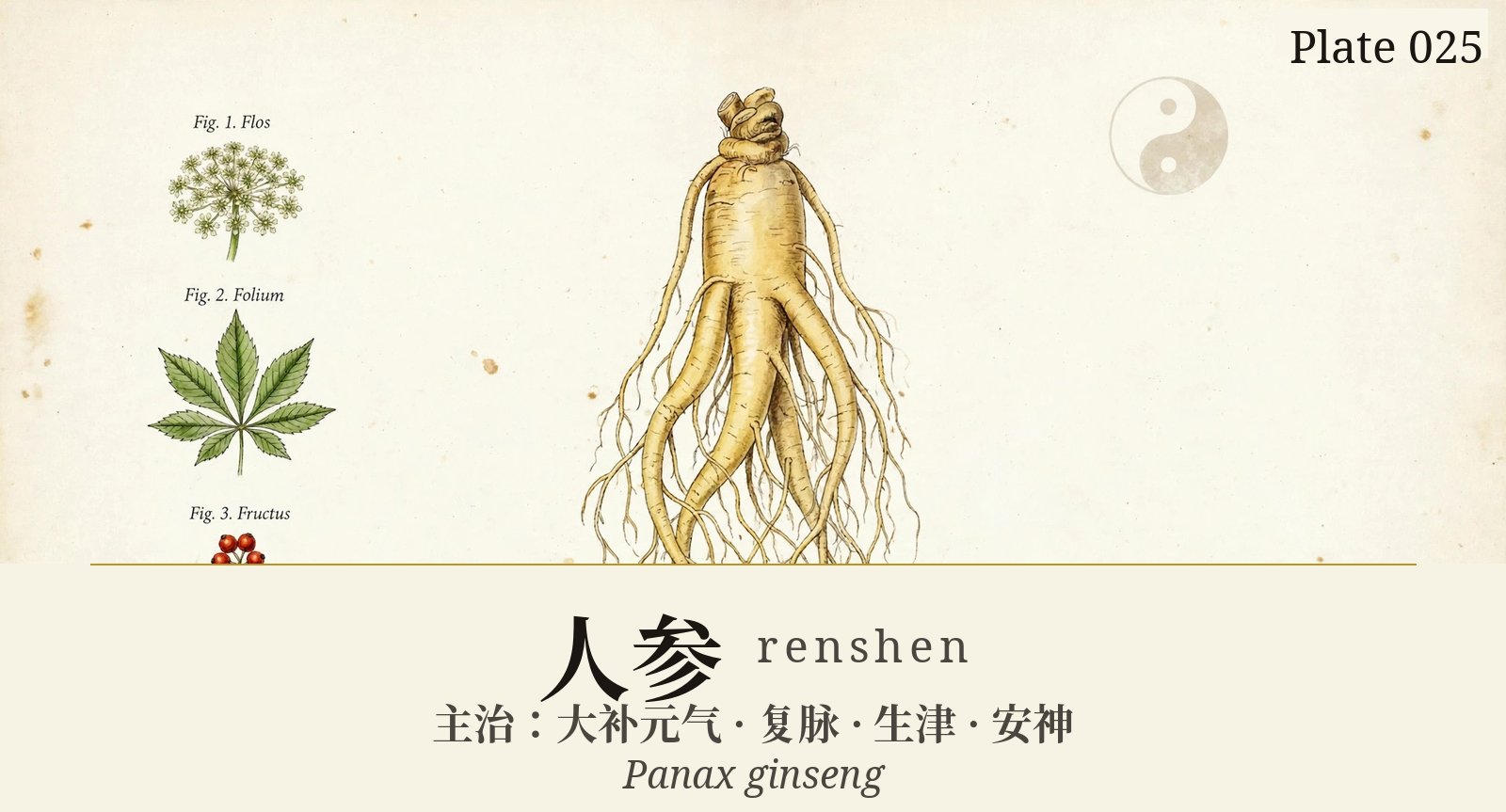
The ClassicThe original text
「味甘微寒。主补五脏,安精神,定魂魄,止惊悸,除邪气,明目,开心益智。久服轻身延年。」
Sweet in flavor, slightly cold. It supplements the five organs, quiets the spirit, settles the soul, stops fright palpitations, expels pathogens, brightens the eyes, opens the heart and sharpens the mind. Taken over a long time, it lightens the body and extends the years.
RootBro's note — Zhang Zhongjing used ginseng chiefly to 'tonify qi, generate fluids, restore the pulse and stem collapse,' mostly at doses of two to three liang. In Baihu Jia Renshen Tang and Zhigancao Tang it is there specifically for injury to both fluids and qi — not for everyday tonification.
PhD InsightA systems-biology reading
Its key constituents, the ginsenosides — over 40 identified — can pull in opposite directions: Rg1 excites the central nervous system while Rb1 sedates it. The overall profile is 'two-way regulation.'
Ginsenoside Rg1 / Rb1 · 人参皂苷
Rg1 → central excitation, better learning and memory (sharpening the mind). Rb1 → central inhibition, anti-anxiety (quieting the spirit). Their ratio decides the overall effect. Ginsenosides also activate the HPA axis → stress adaptation ↑ (the adaptogen effect).
The 'adaptogen' concept: ginsenosides regulate the HPA axis (hypothalamus–pituitary–adrenal), so the body's responses to stresses of every kind — cold, heat, fatigue, infection — normalize rather than skewing toward excitation or suppression. That is the modern biological explanation of 'supplementing the five organs.'